Designing a New Wastewater Treatment Plant under a Low-Carbon Framework: Conceptual Framework, Processes, and Advanced Carbon Accounting Tools
By Dr. Somchai Dararat
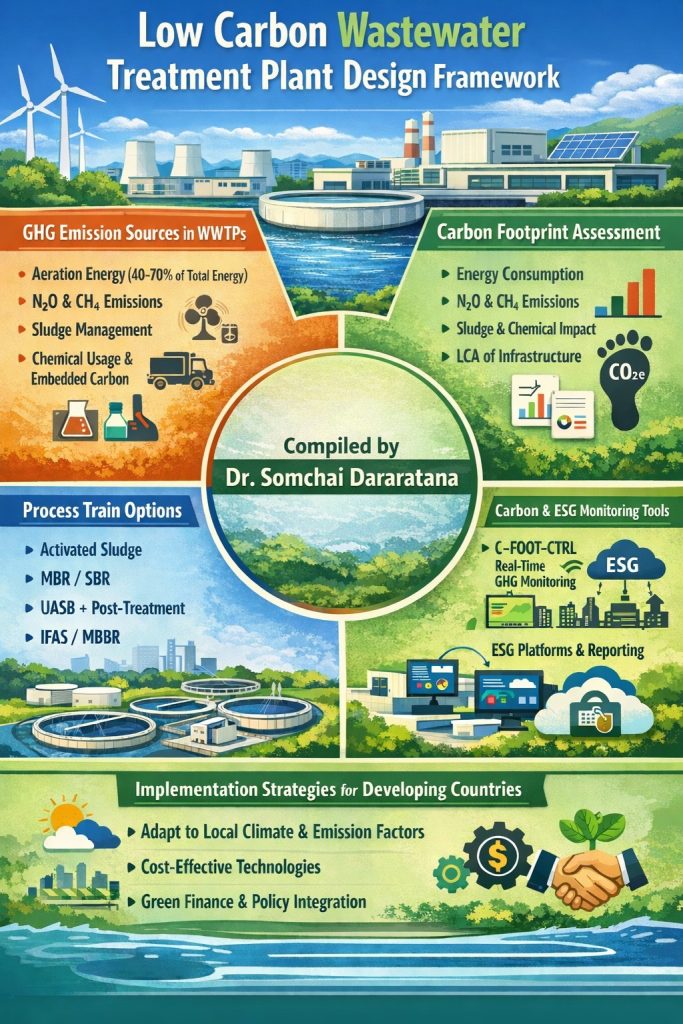
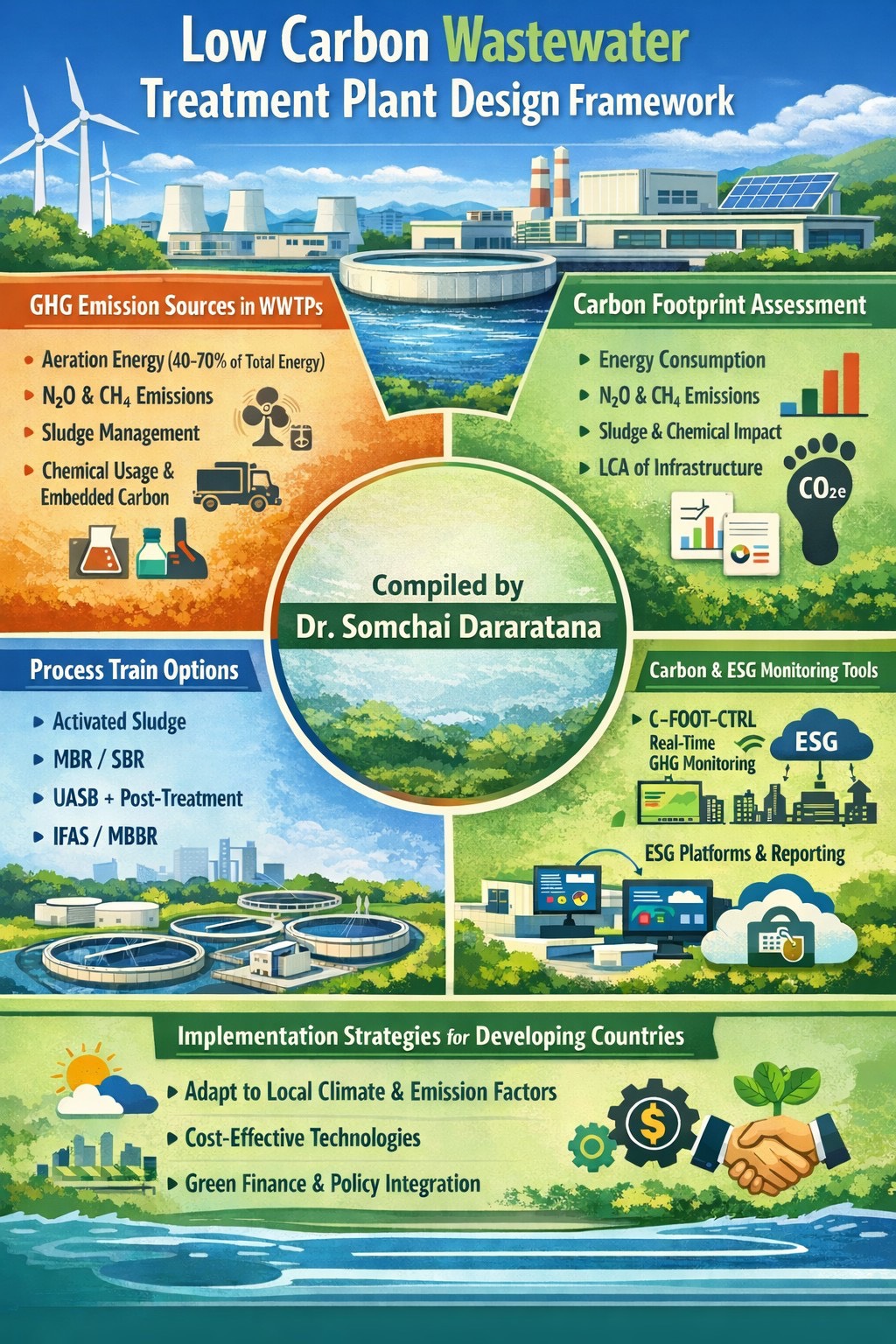
Wastewater treatment plants (WWTPs) are critical environmental infrastructure for protecting water quality. At the same time, they are significant sources of greenhouse gas (GHG) emissions, arising from both energy consumption and biological processes. Designing a new WWTP in the era of a low-carbon economy can no longer focus solely on meeting effluent quality standards; it must integrate carbon footprint analysis from the design stage.
This article presents an academic framework for low-carbon WWTP design by linking:
(1) the specific characteristics of GHG emissions in wastewater treatment systems,
(2) process design and technology selection,
(3) advanced carbon accounting tools and real-time monitoring systems such as C-FOOT-CTRL and ESG platforms, and
(4) practical application in developing country contexts such as Thailand.
1. Introduction
Traditional WWTP design has emphasized compliance with effluent standards, operational reliability, and life-cycle cost. However, under Net Zero targets and emerging GHG reporting requirements aligned with the GHG Protocol and ESG standards, new WWTP designs must consider the “life-cycle carbon footprint” alongside water quality performance indicators.
WWTPs differ from typical industrial facilities because they contain multiple GHG emission sources, including:
- Electricity consumption (especially aeration systems)
- Biological processes emitting N₂O and CH₄
- Sludge and residuals management
- Chemical use and transportation
Designing a new WWTP is therefore a “strategic inflection point” that will determine the system’s carbon emissions trajectory for the next 20–40 years.
2. Characteristics of Greenhouse Gas Emissions in Wastewater Treatment Plants
2.1 Energy Use in Aeration and Pumping Systems
Activated sludge systems and their derivatives (e.g., MBR) are energy-intensive, with aeration typically accounting for 40–70% of total plant energy consumption. Technology selection and aeration system design directly influence carbon emissions.
2.2 N₂O and CH₄ Emissions from Biological Processes
- N₂O arises from incomplete nitrification and denitrification processes.
- CH₄ originates from anaerobic degradation in primary clarifiers, sewer systems, or sludge digestion units.
Both gases have global warming potentials (GWP) many times higher than CO₂. Even small emission quantities can significantly affect the total carbon footprint.
2.3 Sludge and Residuals Management
Sludge digestion, transportation, and final disposal (e.g., landfilling, incineration, or agricultural reuse) contribute both direct and indirect emissions. Designing sludge treatment systems and utilizing biogas are key components of a low-carbon WWTP.
2.4 Chemical Use and Embodied Carbon in Infrastructure
Chemicals such as coagulants, flocculants, disinfectants, and conditioning agents carry embodied carbon from production and transport. Concrete structures and reinforced steel used in tanks and buildings also contain significant embedded carbon that should be considered within a life-cycle assessment (LCA) framework.
3. Conceptual Framework for Low-Carbon WWTP Design
The proposed framework consists of four interconnected layers:
3.1 Wastewater Data and Site Context Layer
- Wastewater characteristics (COD, BOD, TKN, TP, SS, salinity, etc.)
- Flow and quality variability (diurnal/seasonal variation)
- Source type (municipal, industrial, mixed)
- Effluent standards (regulatory or site-specific requirements)
These factors determine the necessary level of process complexity.
3.2 Process Train Options Layer
Example process configurations include:
- Conventional activated sludge + secondary clarifier
- Extended aeration / oxidation ditch
- SBR (Sequencing Batch Reactor)
- MBR (Membrane Bioreactor)
- UASB + post-treatment (e.g., aerated lagoon, activated sludge)
- IFAS or MBBR systems
Each option has distinct energy profiles, N₂O/CH₄ emissions, sludge production rates, and operational complexity.
3.3 Carbon Footprint and Resource Assessment Layer
For each process train, at least four dimensions should be assessed per unit volume treated (e.g., kg CO₂e/m³):
- Electricity consumption (kWh/m³ → kg CO₂e/m³ based on grid emission factor)
- Biological emissions (N₂O and CH₄) using appropriate factors or advanced models
- Chemical consumption (kg/m³ → kg CO₂e/m³)
- Sludge production and management (kg dry solids/m³ → kg CO₂e/m³)
A full LCA may also incorporate embodied carbon of major structures and equipment.
3.4 Multi-Criteria Decision Analysis (MCDA) Layer
Process selection should not rely solely on carbon performance but also consider:
- CAPEX and OPEX
- Flexibility under varying influent conditions
- Operational complexity and staffing requirements
- Odor risk, land footprint, and community acceptance
MCDA allows transparent weighting between “low carbon” and “operational and economic feasibility.”
4. Carbon Accounting and Monitoring Tools for WWTPs
4.1 C-FOOT-CTRL: Real-Time GHG Monitoring and Control
Developed under the Horizon 2020 program, C-FOOT-CTRL demonstrates how sensor networks and data analytics can:
- Monitor GHG emissions (particularly N₂O and CH₄) in individual process units
- Integrate with process control systems to adjust operating conditions and reduce emissions without compromising effluent quality
- Generate time-series datasets for reporting and continuous improvement
Designing new WWTPs to be “sensor-ready” and “data-ready” from the outset enables future transition to real-time carbon management.
4.2 ESG Platforms and Enterprise-Level Carbon Management
Platforms such as Microsoft Sustainability Manager, Persefoni, and IBM Envizi can:
- Aggregate energy, water, and carbon data from multiple plants
- Calculate and report GHG emissions in line with the GHG Protocol
- Align individual WWTP performance with city- or organization-wide Net Zero goals
Creating a digital carbon profile during the feasibility stage helps forecast the plant’s impact on the organization’s overall footprint.
5. Practical Design Framework for a New WWTP
A structured implementation sequence may include:
- Define Context and Objectives
- Target influent flow and quality
- Effluent standards
- Organizational or municipal carbon targets
- Develop Process Scenarios
- Conventional, SBR, MBR, UASB + post-treatment, IFAS/MBBR, etc.
- Sludge management options (anaerobic digestion, biogas utilization, reuse strategies)
- Quantify Carbon Footprint for Each Scenario
- Energy + N₂O/CH₄ + chemicals + sludge
- Use country-specific emission factors and validated models
- Conduct MCDA (Carbon–Cost–Stability–Complexity)
- Rank alternatives
- Select a preferred option and a robust backup option
- Design for Future Carbon Monitoring Integration
- Sensor installation points
- SCADA/IoT systems compatible with ESG platforms
- Data architecture for GHG reporting
6. Application in the Thai Context
Key considerations in Thailand include:
- Tropical Climate Conditions
Emission factors for N₂O/CH₄ may differ from European benchmarks; country-specific factors should be developed or adapted. - Electricity Tariff Structure and Grid Emission Factor
These directly influence carbon intensity of aeration and pumping systems. - Budget and Human Resource Constraints
Technology selection must balance “low carbon” with operational simplicity and maintainability. - Policy and Demonstration Opportunities
A new WWTP can serve as a “living lab” for:- Real-time GHG monitoring systems
- National wastewater carbon accounting methodologies
- Integration with green procurement and green finance mechanisms
7. Conclusion
Designing a new wastewater treatment plant in the low-carbon era is not merely about selecting a technology that meets effluent standards; it is about designing the system’s “carbon architecture.”
By integrating wastewater characteristics, process engineering, carbon footprint assessment, and advanced accounting and real-time monitoring tools, WWTPs can be designed to achieve both environmental performance and alignment with organizational and national Net Zero objectives.